Showing posts with label Handwriting. Show all posts

21 December 2024

Occupations

My favorite go-to resource when trying to decipher a word for an ancestor's occupation is European Roots Genealogy's "List of Old German Professions."  It's a great resource because it not only has a pretty extensive list of word variations used for these occupations/professions, but it also groups them by similar occupations which can help us better understand the different terms that may have been used for our ancestors' professions.  Ernest Thode's German - English Genealogical  Dictionary is also a great source for searching for occupation terms in both German & Latin.  Another good resource to keep in mind is Wörterbuchnetz.de, wich is a digital network of dictionaries in several languages - mainly of the German language, including Old and Middle High German and various dialects, but also including Luxembourgish and Middle Latin.  Wörterbuchnetz has sometimes helped us to decipher the meanings of some of the less common occupations which might not be listed in other resources.  

It is interesting to learn what our ancestors' occupations were, which can help us better understand what kind of lives they lived.  And determining our ancestors' occupations is one important way to differentiate between different individuals with the same name: when there were two men with the same name living in the same town, it can be tricky to figure out which one is "your" man.  (Especially when it seems like most every man in the town happened to be name Johannes or Hanns, and most every woman was named either Maria Anna or Anna Maria). 😉  Say, for example, that you have a record that lists your ancestor, Johannes Schmidt, and says that he was a 'Lehrer,' or teacher.  You want to find more records about him at a later time in his life, but you find that there are records for two different Johannes Schmidts living in the town at the time who were around the same age.  One way you may be able to determine which one is "your Johannes," is to look at his occupation.  Our Bohemian ancestors were very unlikely to make major changes to their occupations, especially for craftsmen after going through the years-long apprentice/journeyman/master process.  So if you take a look at the different records about the two different Johannes Schmidts and see that one was a 'Cantor,' and the other one was a 'Strumpfwirkermeister,' you may wonder if either of these men was "your Johannes" because neither of them was listed as a 'Lehrer' or teacher.  Until you learn that a 'Strumpfwirkermeister' was a master stocking knitter and a 'Cantor' was a choir director & school master - and you see that it is logical that a teacher may have later become a school master.  And if you continue to search for more records, you find that this Johannes Schmidt was also listed as a 'Kapellmeister,' or choir master, in later records.  It's very unlikely that a school teacher would have completely changed occupations and become a master stocking knitter, so gaining an understanding of our ancestors' occupations can sometimes be a reliable way to determine which individuals in the town were in fact our ancestors.

You will likely come across the words "-meister" meaning master, or "-gesell" meaning journeyman along with the words for different occupations, which described different levels of occupations in the guild system.  In Bohemia, as in Germany, many of our ancestors may have been part of the guild system.  Guilds were associations of tradesmen or merchants which served to train new tradesmen, determined which members of the guild had attained 'master' status, controlled the number of tradesmen allowed to work in a specific trade within a town, and protected trade secrets & the guild's interests.  Guilds may have even controlled who their guild member's children were allowed to marry (it's very unlikely that a Master   "Guilds operated on the apprentice, journeyman, and master principle. A young man was assigned to work with a master for several years. During this time, he learned the basics of the trade. After the apprentice attained a certain level of knowledge and skill, he was promoted to journeyman. At this time, he was to travel the land in search of masters in his field for whom he could work and from whom he could learn the requisite skills to become a master himself. When he completed his journeyman time with appropriate skill and knowledge, he would be promoted to master. This was an important step. He could then set up his own shop and work in his field" (from FamilySearch's page on "Guilds in Germany," here).  It is helpful for genealogists to have a basic understanding of the guild system, to understand that our ancestors in these trades may have been apprenticed as a boy, then moved from town to town working as a journeyman as a young man, before settling down and opening a business after becoming a master craftsman.  Interestingly, this is where the word "Masterpiece" originated, meaning the "work by which a craftsman attains the rank of master."  So before the guild would allow a journeyman to become a master, he was first required to create a piece that proved his competence in his trade.  And it's not that unusual as we research our ancestors to find that a journeyman ended up marrying the daughter of the master tradesman, settling down in the town, and working in that trade as a master himself after his father in law retired.  So words like "gesell" (journeyman) and "meister" (master) can be clues to help us follow our ancestors through these stages of their lives.

I've compiled a list with some of the occupations, translations, & examples of the handwritten words for these occupations that we've come across in various old Bohemian & German records:


*Make sure to scroll all the way to the bottom & to the right of the spreadsheet to view the complete occupation list.
Having trouble viewing this chart?  Click here to go directly to this chart on Google Sheets.

01 June 2024

Sample Alphabet Letters

When trying to puzzle out a particularly tricky word, sometimes it helps to see several different examples of how certain Gothic letters were written.  I decided to compile a list of sample letters -- most of these samples came from online matriky books (vital records) on the Czech archive websites, and a few of them came from some of our old family letters.  I placed each letter in relationship to the line as it was written in the original source.


You are welcome to print these sample alphabet letter pages to use as a research help only, please do not use for any other purpose without permission.  Thank you!

26 October 2021

Announcement: Czech Research Seminar in one week!

 I wanted to announce that FamilySearch is hosting a Czech Seminar in one week on November 3rd.  It's a free virtual event which will focus on teaching how to use the gazetteer at GenTeam.at to find out which Czech archive holds the records of the town where you are researching, followed by instruction about how to use each of the Czech Regional Archive websites, and then three classes about reading the birth, marriage, and death parish register books.  I will be leading the instruction about how to use the Litoměřice Regional Archive, and Amy will be leading the instruction on the Plzeň Regional Archive.  And after the seminar the recordings for each of these lessons will be posted on familysearch.org for anyone to view.  Use the link below to register for the seminar.


There is a Czechia Research Seminar Day on Wednesday, 3 November 2021 from 9:00 AM to 4:00 PM MDT.  The classes will be 20 minutes with a 10-minute question and answer. All times are Mountain Daylight Time (MDT). Here is a list of the classes:

9:00 AM - GenTeam Gazetteer and Maps

9:30 AM - Finding Jewish Records at the National Archives

10:00 AM - Plzeň Regional Archives

10:30 AM - Litoměřice Regional Archives

11:00 AM - Prague Regional Archives

11:30 AM - Prague City Archives

12:30 PM - Třeboň Regional Archives

1:00 PM - Zamrsk Regional Archives

1:30 PM - Brno Regional Archives

2:00 PM - Opava Regional Archives

2:30 PM - Reading Czech Parish Registers – Births

3:00 PM - Reading Czech Parish Registers – Marriages

3:30 PM - Reading Czech Parish Registers – Deaths

Click here to learn more, register, and attend: https://churchofjesuschrist.zoom.us/webinar/register/4616074459401/WN_coqRxxuFRbeF-je8rQ2kRA

09 September 2021

J vs. I

I've been teaching my 10 year old niece how to read our ancestors' old Bohemian records, and we came across an excellent example of how the capitol letters I and J were written identically by many German scribes.  In these cases, the only way to differentiate between these two capitol letters is to keep reading: if the letter is followed by a vowel it is a J, or if it is followed by a consonant it is an I.  

Here we see the given names Joseph and Ignaz
written with the same initial letter.


11 March 2021

Litoměřice Archive Website Guide

A user on the Czech FamilySearch Communities recently expressed interest in learning to search for her ancestors using the website for the Litoměřice State Regional Archive (Státní oblastní archiv v Litoměřicích).  After searching online for a good guide to the archive website for English speakers I found that there are some really good resources, but unfortunately they were made a few years ago, and since then the archive website has been changed and those guides are no longer current.  

So I decided to make my own guide.  I ended up making a screen & voice recording -- this is my first time creating something like this (please excuse my pronunciations).  I'm hopeful that this recording will be helpful to those learning to navigate the Litoměřice Archive website.  It also contains examples & tips for those who may be new to searching for their Bohemian and Czech ancestors, regardless of which archives their ancestors' records are found in.

The the Litoměřice State Regional Archive website: http://vademecum.soalitomerice.cz/vademecum/index4Clear.jsp


Here is a break-down of the contents of this recording:

Table of Contents: 0:00 Navigating the Archive website 1:00 Searching for a Town 1:51 Selecting a Book 5:22 Details about a specific Book 6:44 Looking at a Book: Website Tools 8:59 Note: Saving a Direct Link to Scan 9:47 I Found the Book, Now where is my Ancestor? 12:35 Example: Searching for a Birth Record 14:37 Column Headings for Birth Records 19:45 Words Continued on the Next Line 22:55 Getting Back to your List of Books 24:54 Using Books with Indexes  32:33 Page Numbers vs. Folio Numbers 35:25 Example: Searching for a Marriage Record 35:41 Column Headings for Marriage Records 42:25 Meanings of "cross" or "X" Symbols 44:36 Remember, Indexes Aren’t Perfect 46:12 Example: Searching in a Longer Book with Many Towns 55:42 Symbol for the Latinized name ending “us” 57:35 Sources 58:32 Example: Searching for a Death Record 58:47 You CAN do This! (Even if you don’t know the Language) 59:27 Recognizing Patterns  1:00:56 Using Resources such as FamilySearch Communities  1:02:06 Symbol indicating Abbreviations 1:03:29 German Female Surname ending “in”  1:08:00 How to quickly Find the Same Book Again

08 October 2020

Abbreviations

In your research you may have come across a symbol that sometimes resembles a large, loopy 'L,' and then a colon (:).  This 'L:' is a symbol that we've come across in many old Bohemian records meaning that the remainder of the word has been abbreviated.  We have found this symbol used in both German and Latin words.  Sometimes this symbol will follow just one letter and abbreviate the rest of the word, and other times it will follow one or more syllables of a word and replace just one or more letter(s).  I do not know why a priest would sometimes use this 'L:' symbol to indicate that he was abbreviating the end of a word, while at other times the same priest may have chosen to just use a colon (:) to indicate the same thing.

Although it can sometimes prove difficult to learn what the abbreviated word was (especially when there is only one letter followed by this abbreviation symbol), a search of the preceding and following pages in the book will likely reveal that the same word was used again, and often if you search through several pages you may find that the priest sometimes included the word without abbreviating it. 

Abbreviation for 'Promulgation' meaning 'proclamation' (as in the proclamation of marriage banns).

Abbreviation for 'September.'  (Notice that the record directly above this one uses the full word for 'September' without the abbreviation).

Two instances of the abbreviation for 'Hochloeblich' meaning 'highly commendable.'

Two instances of the use of this symbol, in the abbreviation for 'Eheweib' meaning 'wife' & for 'Töchterlein' meaning 'little daughter.'

10 May 2017

Sample Town Names & Family Names

Several years ago my parents called me and told me they were going to the Czech Republic and they wanted to visit some archives to see if they could find any records about our ancestors.  That was back before my parents learned to transcribe the old gothic script, and at that time they didn't have much experience finding the peoples' names & town names in the records.  So I prepared a quick list with sample handwritten names from some of the records that we had for them to reference on their genealogy trip.  It helped them to find the records of our ancestors which they photographed, and we were able to transcribe & later translate them after they returned home.

So if you are just starting out with trying to find the names of places and people in records with Gothic script, it's a good idea to keep copies of sample handwritten names that you have found so far and use them as a reference while you are becoming more comfortable with reading the script.


16 August 2016

Male Given Names in German Gothic Script

As a follow up to my previous post of sample female given names, here is my list of sample male names in the Gothic script:


Female Given Names in German Gothic Script

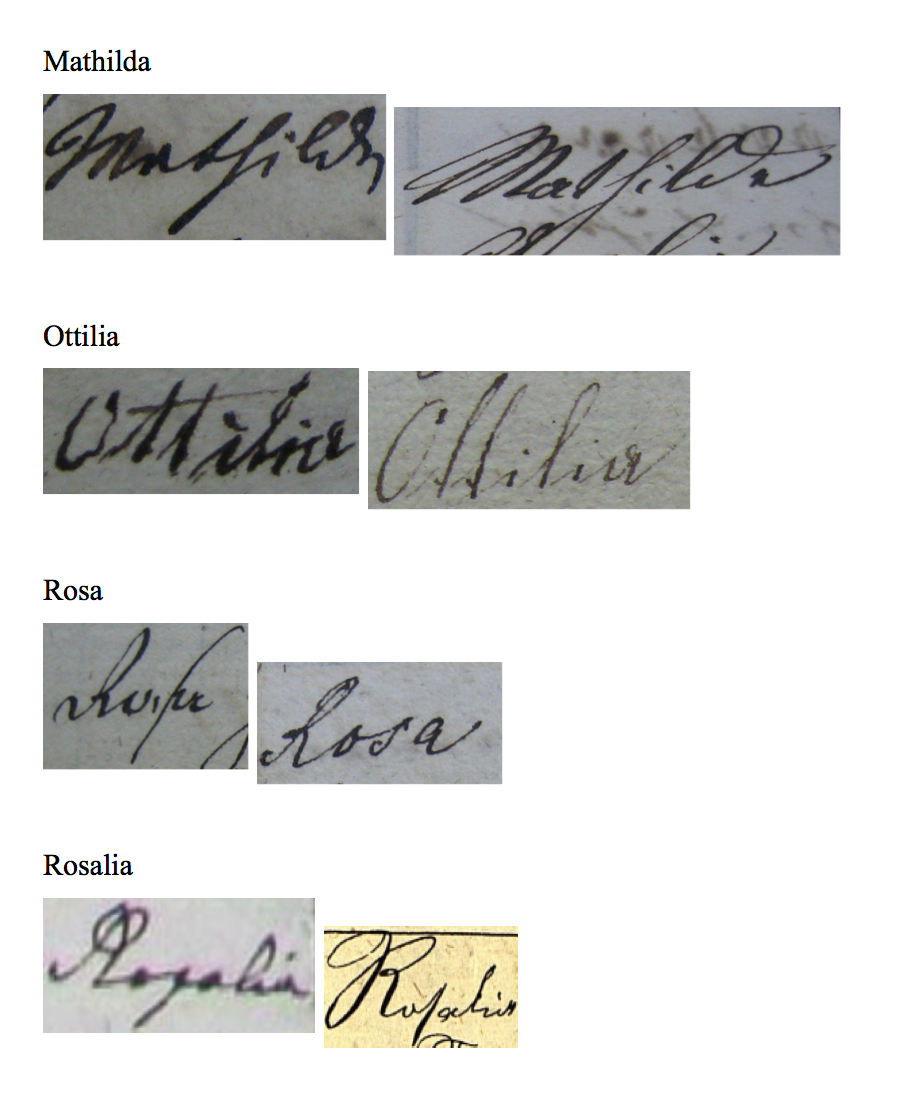
When learning to do Bohemian genealogy research, learning to read the German Gothic script can seem like an overwhelming task.  But with practice, it is possible to learn to decipher the handwriting (even if you don't speak/read German or Latin).  For most beginners, the easiest parts of handwritten vital records to identify are the peoples' names -- especially the more common names such as Anna, Maria, Joannes, Carl, Elisabetha, Andreas, Franz, Katharina, Anton, Georg, Rosina, Joseph, Theresia, Wenzl, etc.

Some time ago I compiled some samples of names in the Gothic script, which I found were helpful especially for beginning researchers who were learning how to recognize the letters and searching for vital records containing specific names.  Each of these samples came from the vital records of my ancestors, which were found on the websites of the Pilsen & Litomerice Archives in the Czech Republic.  I'll start by posting the female given names for now.


And these two cases are worth noting:


Deciphering Handwritten Records

When learning to decipher German & Latin vital records written in Bohemia, an alphabet chart with sample letters can be invaluable.  There are many such sample alphabet charts online, but this is my chart of choice.  This chart sat beside me through my first few years of intense research, and I still reference it today when I get stuck on a tricky bit of handwriting.  

This Alphabet Chart came from the 2011 article, "Helps for Translating That Old 
German Handwriting," an article with several other helpful handwriting samples and tutorials.